
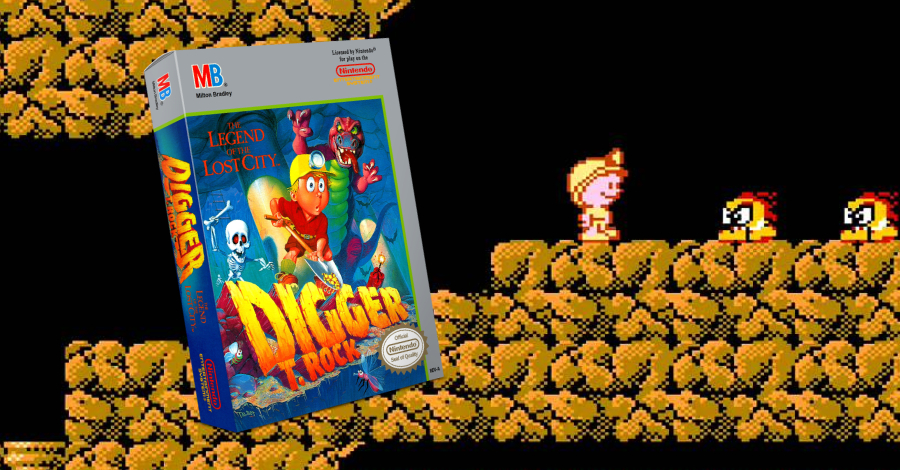
Some NES games greet you with a heroic fanfare and a clear mission. Digger T. Rock greets you by dropping you into the dirt, handing you a shovel, and letting the cave decide whether you deserve to live. Released during that wild era when developers were still figuring out how far the NES could stretch, this Rare-developed oddity is part platformer, part puzzle game, part survival gauntlet, and part cruel joke played on anyone who thought digging for treasure sounded relaxing.
This Digger T. Rock NES review is for players who love the system’s stranger corners: the games that are not quite classics, not quite disasters, but absolutely memorable. Digger T. Rock: Legend of the Lost City is rough, stubborn, and occasionally unfair, but it also has a peculiar charm that keeps pulling you back down into its tunnels.
History: Rare Before the Spotlight Got Too Bright
Digger T. Rock: Legend of the Lost City arrived on the NES in 1990, developed by Rare and published by Milton Bradley. This was before Rare became a household name with Donkey Kong Country, GoldenEye 007, Banjo-Kazooie, and other heavy hitters. On the NES, Rare was everywhere, experimenting constantly, sometimes brilliantly and sometimes recklessly.
Digger T. Rock fits neatly into that early Rare identity. It is ambitious, colorful, mechanically unusual, and not especially interested in holding your hand. Instead of being another left-to-right mascot platformer, it focuses on descending through caverns, solving environmental problems, and managing limited tools. The premise is simple: Digger, an adventurer with a hard hat and a very optimistic attitude, searches for a legendary lost city buried deep beneath the earth.
What makes the game interesting historically is how different it feels from the safer NES releases of the time. It borrows a little from Boulder Dash, a little from arcade platformers, and a little from trial-and-error puzzle design. It is not Rare at its most polished, but it is absolutely Rare at its most curious.
Gameplay: Digging, Dodging, and Improvising Underground
The core loop of Digger T. Rock is easy to explain and much harder to master. Each stage is a cavern filled with dirt, platforms, enemies, hazards, items, and a locked exit. Your job is to explore, dig through soft ground, collect the right tools, and find a way to open the passage to the next area. That sounds straightforward until the game starts throwing falling rocks, disappearing paths, aggressive creatures, lava pits, and awkward jumps into the mix.
Digger can jump, climb ladders, dig, and use items such as dynamite, ladders, and other tools found throughout the caves. The most enjoyable moments happen when a stage feels like a little underground machine. You see a blocked path, spot a useful item, figure out how to reach it, and slowly assemble the solution in your head. When it clicks, Digger T. Rock feels clever in a way many NES platformers do not.
There is also a nice sense of physicality to the caves. Digging changes the space around you, and that makes exploration feel active rather than decorative. You are not just moving through a level; you are carving your way through it. The best rooms encourage you to think before you swing the shovel. Dig too much in the wrong place and you can make your route more dangerous. Waste an item and you might have to restart. Rush forward and the cave will punish you.
The controls are where the enthusiasm starts to wobble. Digger is not as smooth as Mario, not as aggressive as Mega Man, and not as nimble as Simon Belmont in his better moments. He has a slightly stiff, chunky feel, and the collision detection can be fussy. Sometimes a jump that looks reasonable does not quite land. Sometimes an enemy clips you in a way that feels more like a contract dispute than a fair hit. You can adapt, but the learning curve includes learning the game’s quirks as much as learning the stages.
Still, there is something addictive about it. Digger T. Rock has that one more try quality. You fail, complain, swear that the bat definitely cheated, then immediately restart because now you know where the ladder is or which tunnel to dig first. It is not always elegant, but it has hooks.
Graphics: Colorful Caves With Personality
Visually, Digger T. Rock is better than its reputation might suggest. The sprite work has personality, especially Digger himself, who looks like a Saturday morning cartoon adventurer tossed into a deathtrap. The caverns use bold colors and distinct tile work, which helps keep the underground environments from becoming a muddy blur. For an NES game about dirt, it is surprisingly readable most of the time.
Rare’s early visual style is on display here: chunky sprites, expressive enemies, and environments that try to feel busier than the hardware should allow. The game is not gorgeous in the way late NES titles can be, but it has a confident look. You can tell the artists wanted each cave to feel like a hostile little ecosystem rather than a simple collection of platforms.
There are limitations. Some areas repeat visual elements heavily, and the animation can feel a bit stiff. Hazards are usually clear, but not always. In a game this demanding, any visual ambiguity hurts. Even so, Digger T. Rock has enough charm and color to stand out among the gray rubble of forgotten NES curiosities.
Sound: Catchy, Limited, and Very NES
The soundtrack is pure early Rare NES: bright, bouncy, and a little relentless. The main tunes have energy, and they fit the adventurous tone well enough. They are not the kind of tracks you will hum for weeks like the best Capcom or Konami scores, but they do their job. The music gives the game momentum, especially during those tense runs where you are trying to reach an exit before the cave eats your last life.
Sound effects are functional and crunchy. Digging, collecting items, taking damage, and triggering hazards all have that familiar 8-bit snap. Nothing here is luxurious, but the audio supports the action without becoming unbearable. Considering how much time you may spend replaying stages, that matters more than it sounds. A bad NES loop can ruin an already difficult game. Digger T. Rock avoids that trap, even if it never reaches legendary audio status.
Difficulty: The Cave Has No Mercy
Let’s be honest: Digger T. Rock is hard. Not cute hard. Not modern optional challenge hard. This is old-school NES hard, where every mistake feels expensive and the game assumes you are taking notes on graph paper. The early stages ease you in, but the later caverns demand precision, planning, memorization, and a tolerance for pain.
The difficulty comes from several places. Enemies move in annoying patterns. Jumps can be tight. Items are limited. Some paths are not obvious until you have already made a fatal mistake. There is a puzzle logic to many areas, but it is often wrapped in action-platformer pressure. You may understand what to do and still fail because a creature bumps you into a pit at the worst possible moment.
This is the game’s biggest divider. If you enjoy NES games that make you earn every screen, Digger T. Rock can be satisfying. If you prefer fluid controls and generous checkpoints, it may feel like being trapped in a mine with a game designer who personally dislikes you. The challenge is not always perfectly fair, but it is rarely boring. Even frustration has a flavor here.
Modern players should approach it with patience. Use save states if you are playing through a legitimate modern setup that allows them. There is no shame in sanding down the roughest edges of a game from an era that thought limited lives were a personality trait.
Final Verdict: A Flawed NES Gem Worth Excavating
Digger T. Rock is not a lost masterpiece, but it is absolutely a buried treasure for the right kind of player. It has creative level design, a memorable premise, and a distinctive mix of digging, puzzle-solving, and platforming. It also has stiff controls, nasty difficulty spikes, and moments where the line between challenging and irritating gets kicked into a pit.
What saves it is personality. Digger T. Rock feels handmade in that wonderfully weird NES way, back when a game could be built around a strange idea and pushed onto store shelves without being sanded into market-tested mush. It is adventurous, mean, colorful, and oddly lovable. You can feel Rare experimenting underground, not yet the superstar studio it would become, but already willing to take swings.
If you are exploring the NES library beyond the obvious legends, Digger T. Rock deserves a spot on your list. It is best played in short, determined sessions, preferably with a sense of humor and a willingness to learn from failure. For collectors, retro fans, and players who appreciate puzzle-platformers with teeth, this cave is worth entering.
Final score: 7 out of 10. Digger T. Rock is rough around the edges, but its mix of strategy, danger, and offbeat charm makes it one of the more interesting NES adventures hiding beneath the surface.