There’s something weirdly satisfying about going back to old 16-bit games and realising how much deeper they actually were than you remembered. Not because they had cutting-edge graphics or cinematic storytelling, but because they quietly slipped complex systems into what looked like simple fun.
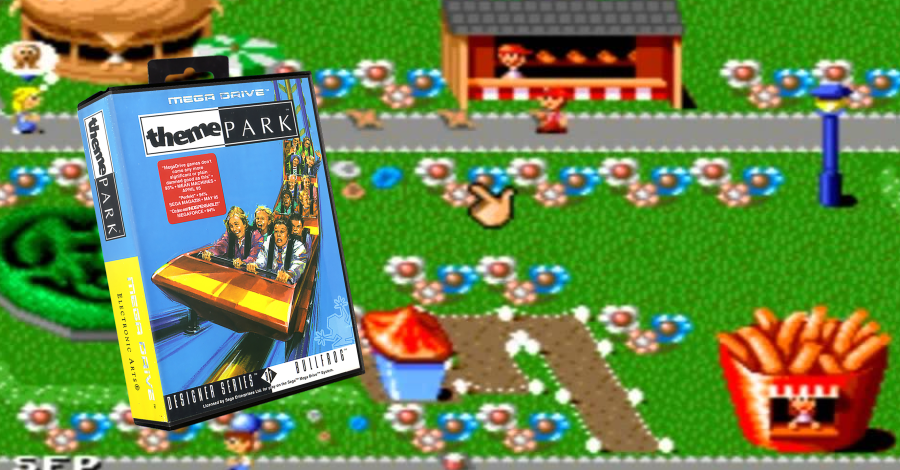
Theme Park on the Sega Mega Drive is one of those games. At first glance, it looks harmless. You build rides. You make a roller coaster. You throw down a few burger stalls. Maybe you let a few guests wander around and scream on a broken ride for your amusement. But the longer you play, the more you realise something slightly sinister is happening underneath all that colourful chaos. You’re not just building a theme park. You’re running a business empire built on overpriced hot dogs and psychological manipulation. And somehow… it works brilliantly.
@briangamesdontsuck Theme Park for the Sega Mega Drive was such a blast! #retrogaming #themepark ♬ original sound – GamesDontSuck
A Sim Game Disguised as a Toy
Released in the mid-90s and developed by Bullfrog Productions, Theme Park was part of a wave of management sims that somehow made spreadsheets feel exciting.
But the Mega Drive version had a very specific identity. It wasn’t just a port of a PC game you weren’t supposed to understand. It was one of the first times console players were handed a systems-heavy sim and told: “Figure it out.” And surprisingly, we did.
The basic loop is simple enough. You start with a patch of land in the UK and a bit of cash. You build rides, attract guests, and try not to go bankrupt.
But very quickly, the game introduces layers that don’t feel like they belong in a “kid-friendly” theme park game:
- Pricing strategy for food and rides
- Staff wages and morale
- Research and development investments
- Supply chain choices
- Guest satisfaction systems
- And yes… the infamous “salt in the fries” mechanic
That last one deserves attention. Because nothing prepares you for the moment you realise the game lets you literally increase customer thirst by adding more salt to food so they spend more money on drinks. It’s genius. It’s slightly evil. And it’s absolutely unforgettable.
The Mega Drive Experience vs Other Versions
One of the most interesting things about the Mega Drive version is how it sits in contrast to the PC original and later console versions. The PC version had more depth. The PlayStation version added 3D ride views and more presentation polish. But the Mega Drive version sits in this awkward but fascinating middle ground. It strips things down just enough to make it accessible, but keeps enough complexity to make it addictive. There’s also something about how it feels on Mega Drive hardware.
It’s snappy. Menu-driven. Fast to navigate. You’re constantly making decisions without getting bogged down in overly complex UI layers. That makes it dangerous in a way modern management games sometimes aren’t. Because you lose time easily. One more ride. One more pricing tweak. One more loan to “fix things later.” Suddenly your park is collapsing and you don’t know why.
Different Countries, Different Challenges
Progression in the Mega Drive version is surprisingly structured. You don’t just build one park forever. You move across different regions, each with its own look and difficulty curve.
You start in the UK with green grass and a gentle introduction to systems. Then you move into harsher environments like deserts and eventually the Australian outback. Each location isn’t just cosmetic. It changes pacing, layout pressure, and how quickly your park can spiral into chaos. The progression system is subtle but effective. It makes you feel like you’re climbing some kind of corporate ladder across continents, one overpriced burger stand at a time. And the further you go, the less forgiving the game becomes. Which is probably why a lot of players never actually finished it.
The Hidden Horror of Guest Behaviour
One of the most underrated parts of Theme Park is how alive the guests feel for a 16-bit game. They don’t just walk around randomly. They react.They get angry when prices are too high. They leave when rides break. They complain when food is overpriced. They panic when queues get too long. And you start to realise something uncomfortable.
You are not designing fun. You are managing satisfaction thresholds like a controlled experiment. Push too hard and they leave. Push too soft and you don’t make money. The entire game becomes a balancing act between exploitation and entertainment. And it’s weirdly accurate to real-world business logic, even if you were too young to realise it at the time.
Monorails, Chaos, and Learning Through Failure
One of the more memorable systems in the game is ride building, especially things like monorails and roller coasters. You don’t just place them. You design them piece by piece. Tracks must connect properly. Layouts must loop. Mistakes can make entire builds unusable. And the game doesn’t really hold your hand.
So what happens? You fail. A lot. Your monorail doesn’t connect properly. Your coaster layout doesn’t loop. Your guests refuse to use a ride you spent 10 minutes building. But that’s part of the charm. Every mistake teaches you something about structure, planning, and patience. It’s unintentionally educational in a way most modern games avoid. There’s no tutorial voice telling you what to do every five seconds. It just says: “Try again.”
Why It Still Works Today
Despite its age and simplicity, Theme Park on the Mega Drive still holds up because its core design philosophy is timeless.
It’s not about graphics. It’s not about realism. It’s about systems interacting with each other. Every decision has a consequence. Every adjustment affects something else. Every small tweak can push your park into profit or disaster. That’s why it still feels engaging today. It respects the player’s intelligence without over-explaining itself. And in an era where many games over-tutorialise every mechanic, that restraint feels almost refreshing.
Final Verdict
The Sega Mega Drive version of Theme Park is not the most advanced version of the game. It’s not the prettiest. It’s not the deepest. But it might be the most important in terms of accessibility. It took a complex PC simulation and turned it into something console players could actually get into without a manual the size of a phone book. And in doing so, it introduced a generation to management games, business systems, and the strangely addictive art of optimising virtual capitalism. All wrapped up in a bright, cheerful theme park.
That’s the irony of it. It looks like a toy. But it plays like a lesson in economics disguised as fun. And somehow, that’s exactly why it still works.