
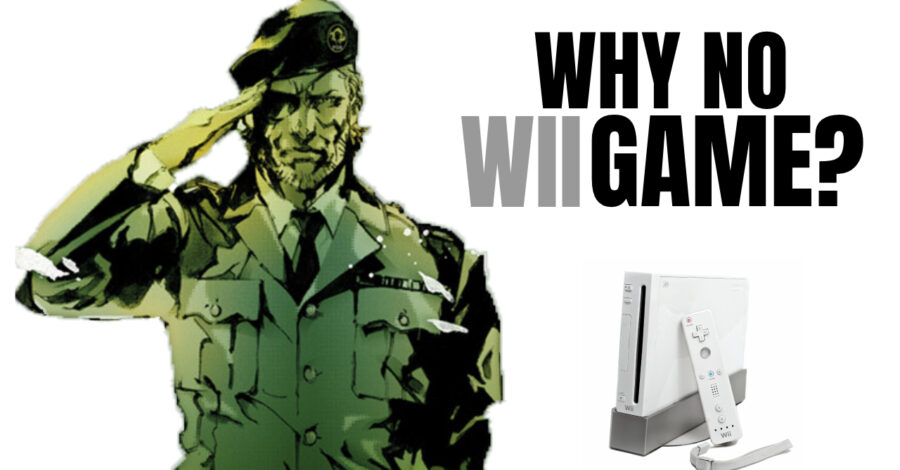
The Nintendo Wii sold over 100 million consoles. It had Resident Evil 4, Call of Duty, GoldenEye, Red Steel and even a Dead Rising port. It even had some surprisingly serious third-party games. And yet… there was never a Metal Gear Solid game on the Wii. Not Metal Gear Solid 4. Not a spin-off. Not a remake. Not even a port of an older game. Nothing. And when you actually stop and think about it, that’s pretty strange. Because if there was one Nintendo console where Metal Gear Solid could have made some sense… surely it was the Wii.
THE OBVIOUS PROBLEM: MGS4
Now, before we get carried away, let’s deal with the obvious objection. Metal Gear Solid 4 was never going to be a Wii game. The PlayStation 3 was considerably more powerful, and MGS4 was built around hardware that the Wii simply didn’t have. So I’m not suggesting that Konami should have somehow squeezed MGS4 onto Nintendo’s little white box. That’s not the interesting question. The interesting question is: Why didn’t Konami make a Metal Gear game specifically for the Wii?
And even more importantly… Why didn’t they port Metal Gear Solid 3?
MGS3 WAS ALREADY THERE
Metal Gear Solid 3 is probably the obvious candidate. It originally appeared on the PlayStation 2. And the PS2 version is important here, because we’re not talking about a PlayStation 3 game. We’re talking about a game from the previous generation. The Wii wasn’t some technologically incapable machine. It was based on technology related to the GameCube, and the GameCube itself had already received a Metal Gear Solid game.
Metal Gear Solid: The Twin Snakes.
So Nintendo owners had already seen a Metal Gear Solid game running on Nintendo hardware. And then something even more interesting happened. In 2012, Konami released:
Metal Gear Solid 3D: Snake Eater
for the Nintendo 3DS. A handheld. A machine dramatically less powerful than the PlayStation 3. And Konami had managed to take one of the most ambitious PS2 games and adapt it for that hardware. Which raises a pretty obvious question.
Why not Wii?
THE WII CONTROLLER WAS PERFECT FOR IT
There’s another reason this feels like such a missed opportunity. The Wii Remote was almost tailor-made for a Metal Gear Solid game. Imagine playing Snake Eater with the Nunchuk. The analogue stick controls Snake. The Z button crouches. The C button switches viewpoints. And then you’ve got the Wii Remote. Point it at the screen… and you’re aiming. Want to shoot? Press the trigger. Want to interact with something? Press a button. Want to use a Wii Zapper? Go for it.
And then there’s CQC. Metal Gear Solid 3 introduced one of the most important combat systems in the series. Grab an enemy. Throw them. Choke them. Interrogate them. Disarm them. The Wii’s motion controls could have been used for some of that. And I’m not saying every action should require you to wildly wave the controller around. Quite the opposite. The best Wii games usually used motion controls where they actually made sense. And Metal Gear had plenty of opportunities for them.
RESIDENT EVIL HAD ALREADY PROVEN THE IDEA
And this is where the Wii’s history makes the omission even stranger. Because Capcom had already demonstrated that a traditional third-person action game could work beautifully with the Wii Remote. Resident Evil 4. The Wii Edition took a game that was originally designed around a conventional controller… and gave it pointer-based aiming. And for many people, that became one of the best ways to play Resident Evil 4. So there was already a blueprint. Konami didn’t have to invent an entirely new control system. They could have looked at Resident Evil 4 and said:
“Okay. What happens if we do this with Metal Gear?”
BUT THERE WAS A BUSINESS PROBLEM
Of course, there’s a reason something doesn’t exist. And there are several possible explanations. The first is the Wii’s audience. The Wii sold enormous numbers of consoles. But much of that success came from games like Wii Sports, Wii Fit and Mario Kart Wii. It wasn’t necessarily the same audience buying Metal Gear Solid. Konami could have looked at the Wii and decided that the traditional Metal Gear audience was primarily on PlayStation. And there was another problem. Kojima.
Hideo Kojima wasn’t simply another developer working on Metal Gear. He was the creative force behind the series. And by this point, Kojima Productions was heavily invested in Metal Gear Solid 4 and the PlayStation 3. Creating an entirely separate Wii Metal Gear would have required money, time and creative resources. And there was no guarantee that Kojima would even want to make it.
BUT THE WII WASN’T A STRANGER TO MATURE GAMES
This is where I think the argument gets interesting. Because you could reasonably say: “Maybe Wii owners didn’t want Metal Gear.” Fair enough. But the Wii still received plenty of mature games. Resident Evil 4. Resident Evil: The Umbrella Chronicles. Dead Space: Extraction. Call of Duty. Red Steel. The Conduit. And eventually GoldenEye 007. So there clearly was an audience for more mature games. The Wii wasn’t exclusively a machine for families playing Wii Sports. There was a market there. The question was whether that market was big enough for Metal Gear.
WHAT ABOUT A COMPLETELY NEW GAME?
And this is where things get really interesting. Because perhaps Konami shouldn’t have ported MGS3 at all. Maybe they should have made something specifically for the Wii. A standalone Metal Gear story. It doesn’t need to be MGS4. It doesn’t even need Solid Snake. Give us a smaller-scale Metal Gear game. Something designed around the Wii’s strengths. Stealth, CQC, Aiming, First-person shooting, Environmental interaction, And maybe even multiplayer.
Imagine Metal Gear gameplay designed from day one around the Wii Remote. That could have been something genuinely different. Not a watered-down MGS4. Not a cheap spin-off. A proper Metal Gear game that existed because of the Wii.
AND THAT’S WHAT MAKES THIS SO WEIRD
Because Metal Gear has appeared on some pretty unexpected hardware. The original games appeared on MSX. Metal Gear Solid appeared on PlayStation. The Twin Snakes appeared on GameCube. Metal Gear Solid 2 and 3 appeared on PlayStation 2. The series eventually came to Xbox. Snake appeared in Super Smash Bros. Metal Gear Solid 3 was even adapted for the Nintendo 3DS. But somehow… the Wii got nothing. And that’s the part I can’t quite get my head around. The console sold more than 100 million units. It had a controller that could have worked incredibly well with the series. It had a huge casual audience that Konami could potentially have introduced to Metal Gear. And it had hardware capable of running games from the PS2 generation. Yet during the entire lifespan of the Wii… Snake never showed up.
SO SHOULD THERE HAVE BEEN A WII METAL GEAR?
Honestly? Yes.
I’m not saying Metal Gear Solid 4 should have been ported. It shouldn’t. And I’m not saying a Wii Metal Gear would automatically have been a masterpiece. It might have been terrible. But that’s not really the point. The point is that the ingredients were there. A massive install base. A unique controller. A successful market for mature games. A previous Nintendo Metal Gear release. And, eventually, even proof that Metal Gear Solid 3 could be adapted to Nintendo hardware. The Wii didn’t need MGS4. It needed something built for the Wii. And perhaps the easiest option of all would have been to take Snake Eater… adapt it… give Snake a Wii Remote… and let us disappear into the jungle.
Maybe there was never enough demand. Maybe Kojima wasn’t interested. Maybe Konami simply didn’t think the investment was worthwhile. We’ll probably never know exactly what happened behind the scenes. But every time I look at the Wii… and then look at Metal Gear Solid 3 on the 3DS… I can’t help thinking the same thing.
How did we never get Metal Gear Solid on the Wii? And honestly… I think that’s one of gaming’s great missed opportunities.