Some Mega Drive games are good because they were impressive for their time. Others are good because they still feel electric the second you pick up the controller. Shinobi 3: return of the ninja master sega mega drive belongs firmly in that second group. This is not just one of Sega’s better action games; it is one of the cleanest, sharpest, most confident 16-bit side-scrollers ever released. It moves like it has a blade pressed against its own throat, fast, focused, and absolutely unwilling to waste your time.
Coming after the beloved The Revenge of Shinobi, this sequel had a nasty job. It had to respect what players already loved while pushing Joe Musashi into something more dynamic, more cinematic, and more aggressive. The result is a game that feels less like a cautious sequel and more like Sega cracking its knuckles. Shinobi 3 is stylish, demanding, and ridiculously replayable, the sort of cartridge that reminds you why the Mega Drive had such a hard-edged identity in the first place.
History: Joe Musashi Returns With Serious Intent
Released in 1993, Shinobi 3: Return of the Ninja Master arrived during the Mega Drive’s golden era, when Sega was firing out games with attitude and speed. The Shinobi name already carried weight. The arcade original had established the fantasy of the modern ninja battling criminal armies, while The Revenge of Shinobi brought that formula home with moody music, tight action, and unforgettable boss fights.
Shinobi 3, however, did not simply repeat the previous game. It refined it. Sega slowed down the stiffness, expanded the move set, and gave Joe Musashi the kind of acrobatic mobility that makes him feel like a true ninja rather than a man carefully stepping through danger. You can sense the developers looking at everything that worked before and asking, how do we make this smoother, faster, and cooler?
The story is classic 16-bit action nonsense in the best way. The evil Neo Zeed organization is back, and Joe Musashi has to slice, kick, jump, and ninjutsu-blast his way through an army of cybernetic soldiers, mutants, military hardware, and bizarre bosses. It is not deep, but it does not need to be. The plot is a fuse. The levels are the explosion.
Gameplay: Fast, Fluid, and Still Fantastic
The first thing you notice when playing Shinobi 3: return of the ninja master sega mega drive is how good Joe feels to control. This is the kind of action platformer where movement is the main event. Joe can run, crouch, jump, double jump, wall jump in specific spots, slash at close range, throw shuriken from a distance, block certain projectiles, and unleash screen-clearing ninjutsu attacks. He can even perform a flying kick and a downward sword strike, both of which make combat feel more physical than in many older side-scrollers.
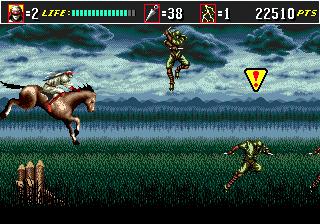
That expanded toolset matters because Shinobi 3 constantly mixes up its situations. One moment you are carefully picking off enemies from across the screen, the next you are sprinting through a burning forest, clinging to walls, riding a horse, surfing across water, or blasting through a high-speed facility. The game has a real sense of pace. It understands when to test precision, when to let you feel powerful, and when to throw something wild at you just because it can.
The combat is simple on paper but wonderfully satisfying in practice. Distance is everything. If an enemy is far away, Joe throws shuriken. If they get close, he cuts them down with his sword. That automatic switch between ranged and melee attacks gives every encounter a snappy rhythm. You are constantly managing spacing, timing jumps, and deciding when to burn one of your limited ninjutsu spells.
Those magic attacks are not just flashy panic buttons. They are strategic tools. One spell boosts your jumping ability, another shields you from damage, another rains lightning across the screen, and another sacrifices health for a devastating attack. Using them well can turn a brutal boss fight into a controlled duel. Wasting them can leave you sweating later.
Level Design: Variety Without Losing Focus
Shinobi 3 is not a long game, but it is packed. Each stage has its own identity, and the game avoids the trap of feeling like the same corridor with different wallpaper. The opening forest stage is iconic because it immediately sells the fantasy. Joe dashes beneath trees, enemies leap from the background, and the music pushes you forward like a drumbeat in your skull.
Later stages get more mechanical, more surreal, and more dangerous. You fight through industrial zones, enemy bases, biological nightmares, and vehicle sequences that feel like Sega showing off. The horse-riding stage could have been a gimmick, but it is genuinely fun, giving the game a cinematic rush without turning into a sloppy mini-game. The surfing section is similar: fast, stylish, and just dangerous enough to keep your hands tight around the controller.
What I appreciate most is that the levels rarely overstay their welcome. Shinobi 3 keeps moving. There is no bloated filler, no maze-like padding, and no endless backtracking. It is an action game with discipline, and that discipline makes it easy to replay. Once you know the stages, you start chasing cleaner runs, fewer hits, better boss strategies, and smoother movement.
Graphics: Peak Mega Drive Style
Visually, Shinobi 3 is a knockout. It may not be the most colorful Mega Drive game, but it has style pouring out of every pixel. Joe Musashi’s animation is superb. His run, sword slash, jump, and idle stance all carry weight and personality. He looks calm and deadly, which is exactly what you want from a ninja master.
The backgrounds are loaded with atmosphere. The game uses parallax scrolling beautifully, especially in outdoor stages where trees, rocks, and distant scenery create a convincing sense of depth. Industrial areas have that gritty Sega metal-and-neon mood, while the more grotesque stages lean into strange biological horror. It is not just pretty; it has texture.
Enemy designs are also excellent. You get masked soldiers, martial artists, robots, mutants, and bosses that look like they wandered in from a fever dream of 90s anime and arcade cabinets. Some bosses are huge, some are weird, and most are memorable. The animation remains impressively smooth even when the screen gets busy, which helps the game feel fair. When you take a hit, it usually feels like your mistake, not the hardware giving up.
Sound: Yuzo Koshiro Energy, Sega Attitude
The Revenge of Shinobi is famous for Yuzo Koshiro’s soundtrack, and while Shinobi 3 has a different musical flavor, it still sounds unmistakably Sega. The music is punchy, driving, and perfectly matched to the game’s speed. It blends rock, electronic rhythms, and cinematic action cues into tracks that make you want to keep pushing forward.
The opening stage theme alone sets the tone: urgent, cool, and dangerous. It does not sit politely in the background. It grabs the game by the collar. The Mega Drive’s sound chip can be divisive in the wrong hands, but here the crunchy tones work beautifully. The percussion hits hard, the melodies stick, and the overall sound has that metallic 16-bit edge that defined so many Sega classics.
Sound effects are equally satisfying. Shuriken throws are crisp, sword hits have bite, explosions crackle, and ninjutsu attacks feel powerful. There is a physicality to the audio that supports the action. Every slash, impact, and burst of magic adds to the rhythm of play.
Difficulty: Tough, But Usually Fair
Shinobi 3 is not a pushover. It comes from an era when games expected you to learn patterns, improve reflexes, and accept that rushing blindly would get you punished. That said, it is far more approachable than many 16-bit action games. The controls are responsive, Joe has a generous move set, and the game gives you enough tools to survive if you pay attention.
The challenge comes from enemy placement, boss patterns, environmental hazards, and the pressure of limited resources. Some sections can absolutely shred a new player, especially vehicle stages and later bosses. But Shinobi 3 rarely feels cheap. Once you understand what the game is asking, you can execute a better plan. That is the sweet spot. You die, you curse, you restart, and then you come back sharper.
Boss fights are a highlight because they reward observation. You cannot just mash attack and hope. You need to learn when to jump, when to strike, when to use ninjutsu, and when to stay patient. On higher difficulty settings, the game becomes a serious test, but not an unreasonable one. It is the kind of difficulty that makes a successful run feel earned.
Final Verdict: One of the Mega Drive’s Essential Action Games
Shinobi 3: return of the ninja master sega mega drive is a masterpiece of 16-bit action design. It is fast without being messy, stylish without being shallow, and challenging without feeling cruel. Sega took an already great series and gave it the speed, animation, and variety it needed to become something truly special.
What makes it hold up so well is the feel. Plenty of retro games are worth respecting, but not all of them are still this much fun to actually play. Shinobi 3 is. The controls are sharp, the stages are exciting, the presentation is strong, and the whole thing has that unmistakable arcade-born confidence. It is a game built for repeat play, for mastering movement, for shaving mistakes off each run until Joe Musashi feels like an extension of your hands.
If you own a Sega Mega Drive, this belongs in your collection. If you love action platformers, it belongs near the top of your play list. And if you have only ever heard people praise Shinobi 3 from a distance, believe the hype. This is Sega at full strength, delivering ninja action with style, speed, and just enough danger to make every victory taste sweet.
Score: 9.5/10
Buy Shinobi 3: return of the ninja master sega mega drive on eBay
Looking for a copy of Shinobi 3: return of the ninja master sega mega drive?
View current eBay listings