
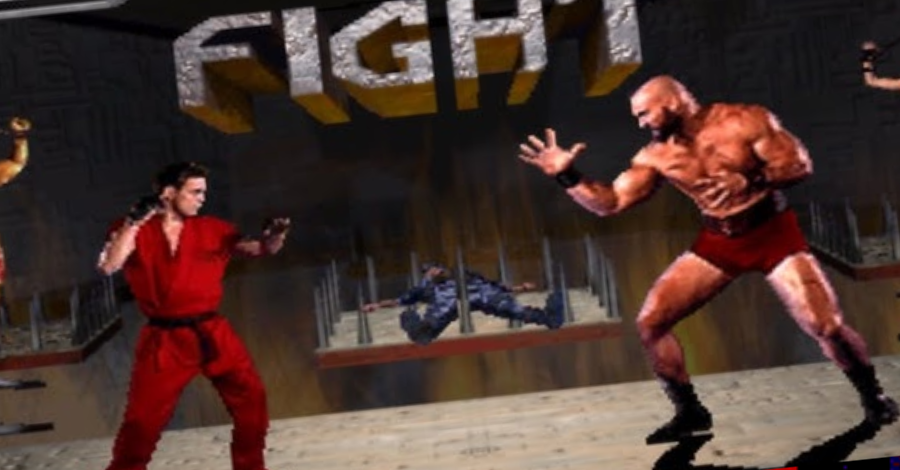
Few video games have a reputation quite as bizarre as Street Fighter: The Movie.
Not only was it based on the infamous live-action Street Fighter starring Jean-Claude Van Damme and Raúl Juliá, but it also tried to transform one of gaming’s most beloved fighting franchises into a digitised Mortal Kombat-style experience.
The result is one of the weirdest fighting games ever released on the original PlayStation — a game that feels like a fever dream created during the most chaotic years of the 1990s console wars.
And honestly? That’s exactly why people still talk about it.
@briangamesdontsuck Street Fighter The Movie …. The Game. Released in 1995 for the PlayStation 1 and the Sega Saturn. #streetfighter ♬ original sound – GamesDontSuck
A Movie Tie-In That Looked Nothing Like Street Fighter
The original arcade version of Street Fighter: The Movie already shocked fans by replacing Capcom’s iconic animated sprites with digitised actors based on the movie cast.
Suddenly:
- Guile looked exactly like Jean-Claude Van Damme
- Bison resembled Raúl Juliá
- Ken and Ryu looked like actors from a low-budget action series
- Everyone moved with stiff live-action animation
For longtime Street Fighter fans, it was surreal.
By the time the PlayStation version arrived, things became even stranger. Instead of simply porting the arcade release, Capcom created a heavily altered console version with extra modes, hidden characters, and gameplay tweaks that made it feel almost like an alternate universe version of Street Fighter.
The Gameplay
At its core, the game still follows traditional Street Fighter mechanics:
- Six-button fighting controls
- Fireballs and special moves
- One-on-one matches
- Combos and super attacks
But everything feels slightly “off.”
The digitised sprites lack the fluidity of Super Street Fighter II Turbo, and the movement can feel stiff compared to Capcom’s best fighters of the era. Yet underneath the awkward presentation is a surprisingly competent fighting engine.
In fact, some competitive players later discovered that the PlayStation version had far more depth than people originally assumed.
The game even introduced mechanics that resembled later combo systems seen in more advanced fighters.
Raul Julia Steals the Entire Game
No matter how bizarre the gameplay becomes, the real star is Raúl Juliá as M. Bison.
His performance in the film was already legendary, bringing theatrical energy and genuine charisma to a movie that could have easily been completely disposable. That same energy carries directly into the game through the digitised footage.
Every time Bison appears on screen, the game suddenly becomes entertaining on an entirely different level.
It’s impossible not to smile when the game fully embraces its ridiculousness.
The PlayStation Version’s Hidden Weirdness
One reason the PlayStation version developed a cult following is because it contains an absurd amount of hidden content.
There are alternate versions of characters, secret fighters, strange unlockables, and bizarre gameplay experiments scattered throughout the roster. It almost feels like Capcom’s developers were using the game as a sandbox to test strange ideas.
That gives the game a fascinating identity today.
While many bad licensed games become boring after a few minutes, Street Fighter: The Movie remains consistently entertaining simply because you never quite believe what you’re looking at.
Why Fans Rejected It
The biggest problem was timing.
During the mid-1990s, fighting games were evolving rapidly. Players already had access to masterpieces like:
- Street Fighter Alpha
- Tekken 2
- Mortal Kombat 3
Compared to those games, Street Fighter: The Movie felt awkward and outdated almost immediately.
Fans wanted beautiful sprite animation and precise gameplay — not digitised actors awkwardly throwing fireballs at each other.
Final Verdict
Street Fighter: The Movie is not a classic in the traditional sense. It’s clunky, awkward, visually bizarre, and completely unlike what most fans wanted from Street Fighter.
But it’s also one of the most fascinating fighting games of the 1990s.
It represents a strange period where publishers were desperately chasing the success of digitised graphics after Mortal Kombat exploded in popularity. The result is a game that feels equal parts parody, experiment, and genuine fighter.
For retro gaming fans, it’s absolutely worth revisiting — not because it’s perfect, but because there has never been another Street Fighter game remotely like it.