
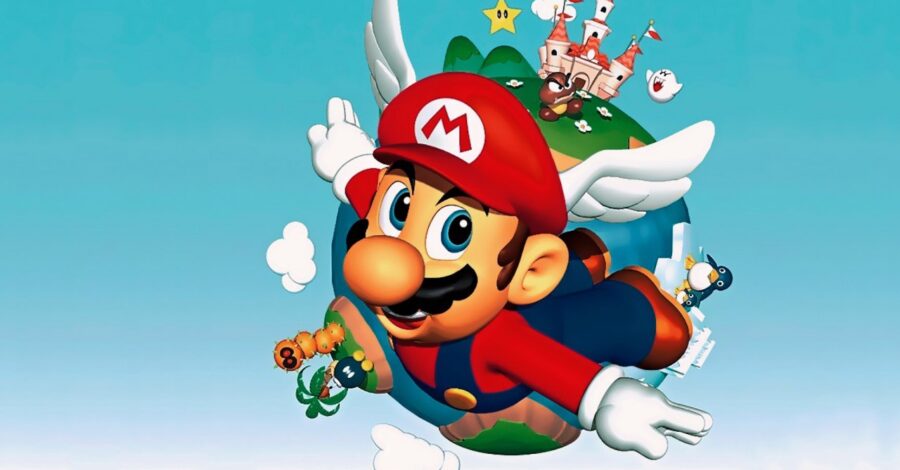
History: The Leap That Changed Everything
There are important games, and then there are games that kick the door off its hinges and rearrange the entire room. Super Mario 64 is one of those games. Released alongside the Nintendo 64 in 1996, it did not just bring Mario into 3D; it taught millions of players what 3D movement could feel like. Before analog sticks became standard, before free camera control was second nature, before every mascot platformer tried to build a collect-a-thon playground, Nintendo handed us Princess Peach’s castle and said, “Go explore.”
Playing super mario 64 n64 today is like digging up the blueprint for modern 3D games. You can feel its fingerprints on everything from Banjo-Kazooie to Ratchet & Clank to open-world adventures that have nothing to do with plumbers or power stars. What is wild is how little of its magic feels trapped in 1996. Yes, it is old. Yes, the camera has opinions. But the core design is still electrifying because it is built around a simple idea: moving Mario should be fun before you even start chasing objectives.
Gameplay: Movement Is the Main Attraction
The first thing that hits you is Mario himself. He runs, jumps, flips, dives, slides, wall-kicks, swims, crawls, punches, and long-jumps with a springy confidence that still feels fantastic. The analog stick gives him a range of motion that was revolutionary on the N64, and the game makes sure you use every bit of it. Just messing around in the castle courtyard can eat ten minutes because chaining a triple jump into a dive, then popping up into a backflip, feels like playing with a toy that never stops being satisfying.
The structure is brilliant. Peach’s castle acts as a hub world, and paintings lead to themed stages where you collect Power Stars. Instead of forcing a straight line, each course is a sandbox with multiple goals. Bob-omb Battlefield asks you to race Koopa the Quick, defeat King Bob-omb, blast to a floating island, and sniff out hidden red coins. Cool, Cool Mountain turns a snowy slope into a playground of slides, penguins, and risky shortcuts. Lethal Lava Land, Jolly Roger Bay, Wet-Dry World, Tick Tock Clock; every level has a strong identity and at least one moment that burns itself into your memory.
What makes the design sing is that most stars are not just collectibles tossed into empty space. They are mini challenges. Some test platforming, some test exploration, some ask you to understand the level’s mechanics, and some are pure chaos. The game rewards curiosity constantly. See a strange ledge? Try to reach it. Notice a cannon? Find the Bob-omb Buddy. Spot coins arranged in a weird pattern? There is probably a secret nearby. It is compact by modern standards, but almost nothing feels wasted.
The Camera: The One Real Battle
Let’s not pretend the camera is perfect. Lakitu’s camera system was a pioneering solution, but it can fight you in tight spaces, especially in stages like Hazy Maze Cave or inside the pyramid in Shifting Sand Land. Sometimes it refuses the angle you want; sometimes it snaps back like it has a personal grudge. Still, the game usually gives enough room to recover, and the movement is so responsive that you learn to play around the camera’s quirks. It is a blemish, not a dealbreaker.
Graphics: Chunky, Colorful, and Full of Personality
Super Mario 64 will not impress anyone looking for modern texture detail, but that is the wrong lens. On original N64 hardware, this game is bold, readable, and bursting with charm. Mario’s model is simple, yet expressive. Enemies are chunky toy-box creatures. Worlds use bright colors and strong shapes so you instantly understand where to go, what is dangerous, and what can be climbed, jumped on, or explored.
The low polygon look has aged better than many early 3D games because Nintendo leaned into clean art direction instead of chasing realism. Peach’s castle still feels iconic, with its red roof, stained glass portrait, and mysterious locked doors. The levels are abstract in that classic Nintendo way, but they communicate mood beautifully. Dire, Dire Docks feels serene and lonely. Big Boo’s Haunt is spooky without being miserable. Rainbow Ride looks like a nightmare for people afraid of heights, and honestly, it plays like one too.
Sound: Whistles, Wahs, and Pure Nintendo Joy
Koji Kondo’s soundtrack is a major reason this game lives rent-free in so many brains. The main theme is cheerful and adventurous without becoming annoying, which is good because you will hear it a lot. The underwater music is gentle and dreamy, one of the most beautiful tracks on the system. Bowser’s stages bring a darker, marching energy that makes those obstacle courses feel like real tests.
The sound effects deserve just as much love. Mario’s voice, performed by Charles Martinet, gives the character a personality explosion. The “Yahoo!” during a long jump, the little yelps, the exhausted breathing when low on health, the triumphant star grab; it all makes Mario feel alive. Even simple effects like coin pickups and door unlocks have that crisp Nintendo feedback that tells your brain, yes, you did something good.
Difficulty: Friendly Until It Decides Not to Be
Super Mario 64 is welcoming, but it is not toothless. You only need 70 stars to reach the final Bowser fight, so the game lets you skip challenges that make you want to throw the controller into the nearest couch cushion. That flexibility is one of its smartest choices. New players can enjoy the adventure without mastering every brutal coin hunt, while completionists can chase all 120 stars and discover where the real pain lives.
The difficulty curve is mostly fair. Early stages teach movement naturally, mid-game levels add hazards and verticality, and later stages demand precision. Tick Tock Clock is a mechanical gauntlet where timing matters. Rainbow Ride turns every carpet ride into a sweaty-palmed commitment. Some 100-coin stars are patience tests, especially when one bad fall means starting over. The game can be cruel, but it rarely feels lazy. Most failures come down to movement, awareness, or the camera getting spicy at the worst possible second.
Final Verdict: A Classic That Still Has the Sauce
Reviewing super mario 64 n64 in the modern era is tricky because its influence is so massive that parts of it now seem obvious. But that is exactly the point. This game invented so much of the language that later 3D platformers speak fluently. More importantly, it remains fun. Not “historically interesting” fun. Not “for its time” fun. Actual, controller-in-hand, one-more-star fun.
Its rough edges are real. The camera can annoy you, a few stars are awkward, and early 3D geometry has moments where depth perception becomes a personal enemy. But the highs are legendary. The freedom of movement, the variety of objectives, the unforgettable hub, the music, the secrets, the sheer confidence of the whole thing; Super Mario 64 is still a must-play for anyone who cares about platformers.
If you are collecting for the Nintendo 64, this belongs on the shelf. If you are revisiting it after decades, it will probably make you grin within five minutes. If you have never played it, understand this: you are not just playing an old Mario game. You are playing the moment 3D gaming found its legs and started running.
Score: 9.5/10
Buy super mario 64 n64 on eBay
Looking for a copy of super mario 64 n64?
View current eBay listings