
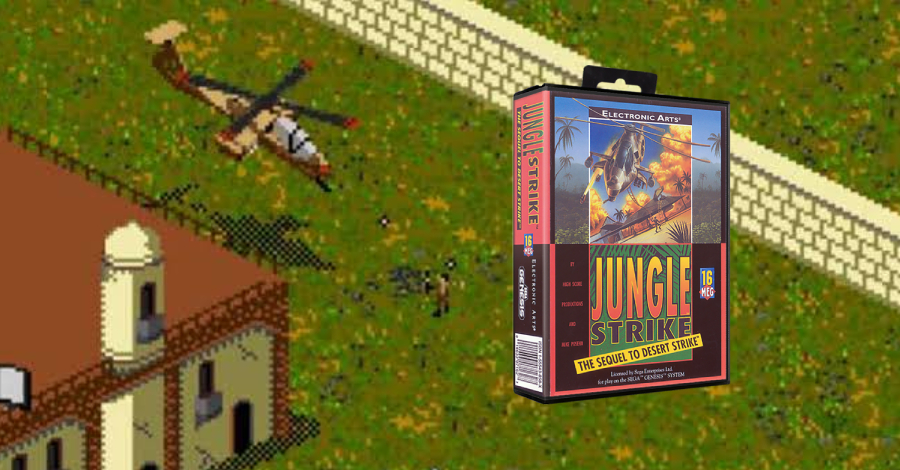
There are Mega Drive games you remember because they were pretty, and then there are games you remember because they made your palms sweat. Jungle Strike belongs firmly in the second camp. This is not a polite little arcade shooter where you drift left, mash fire, and admire the explosions. This is a tense, objective-heavy combat sandbox where every fuel barrel matters, every civilian pickup feels like a miniature rescue movie, and every missed shot can turn a tidy mission into a smoking crater.
Released for the Sega Mega Drive during EA’s golden run of chunky cartridges and bold ideas, jungle strike is the sequel to Desert Strike, and it does exactly what a sequel should do: it keeps the core concept, raises the stakes, adds variety, and makes the world feel bigger. It is awkward, brilliant, punishing, and still weirdly addictive decades later.
History and Context
Jungle Strike arrived in 1993, developed by High Score Productions and published by Electronic Arts. At the time, Desert Strike had already proved that a military action game did not need to be a simple side-scroller or top-down blast-fest. Its isometric helicopter combat mixed action, strategy, resource management, and mission planning in a way that felt unusually ambitious for a 16-bit console.
The sequel came out during an era when action games were getting louder, faster, and more cinematic. Instead of simply sending players back to the desert, EA escalated the conflict with a story involving a terrorist threat against Washington D.C. and a villainous alliance cooked up in the wonderfully exaggerated style of early 90s action thrillers. Subtle? Not even slightly. Effective? Absolutely.
What makes jungle strike stand out historically is how confident it feels. It does not behave like a quick cash-in. The Mega Drive version is packed with mission variety, including helicopter sections, hovercraft segments, motorcycle action, and even on-foot moments. Not every experiment lands perfectly, but the ambition is obvious, and that ambition is a huge part of why the game is still talked about.
Gameplay: Tactical Chaos from the Cockpit
The core of Jungle Strike is still its helicopter combat, viewed from an isometric angle that gives the battlefield a board-game-like clarity while keeping the action hot. You pilot an attack chopper through hostile territory, destroying targets, rescuing prisoners, protecting key locations, capturing enemies, recovering items, and trying very hard not to run out of fuel halfway across the map.
That last part is crucial. This is not just a shooter. It is a shooter with errands, and I mean that as a compliment. You are constantly juggling ammo, armor, fuel, mission objectives, and map awareness. The game expects you to think before you charge in. If you waste Hellfire missiles on low-priority targets, you may not have enough firepower when a bunker or armored vehicle blocks your next objective. If you ignore fuel dumps, you will watch your aircraft drop from the sky like a very expensive mistake.
The controls take a little getting used to, especially if you are coming from more direct action games. The helicopter has momentum, and aiming from an isometric perspective can initially feel like trying to swat flies while standing on a rotating dinner plate. But once it clicks, it becomes satisfying in that old-school Mega Drive way. You learn to circle targets, approach carefully, fire in controlled bursts, and use distance to your advantage.
Mission design is the real star. Jungle Strike gives you a list of objectives and lets you tackle much of the map with a sense of freedom. You are not being dragged down a straight corridor. You are scouting, prioritizing, retreating to resupply, and deciding when to risk a dangerous push. That creates stories. Maybe you limp back to a landing zone with one tick of armor left. Maybe you rescue the final hostage while anti-aircraft fire chews through your hull. Maybe you miss a pickup by a pixel and shout at the television. That is Jungle Strike doing its job.
Vehicle Variety
The sequel expands beyond the helicopter, and this is where opinions can split. The hovercraft sections add a different rhythm, while the motorcycle and on-foot parts break up the aerial action. Are these sections as refined as the chopper gameplay? Not really. The helicopter is the heart of the experience, and everything else feels slightly less elegant. Still, the extra vehicles add personality and prevent the campaign from becoming repetitive. Even when they are clunky, they make the game feel larger than its predecessor.
Graphics and Presentation
For a Sega Mega Drive game, Jungle Strike has a strong visual identity. The isometric environments are detailed, readable, and surprisingly varied. You get urban zones, jungle terrain, military bases, rivers, coastlines, and enemy compounds, all built from crisp tiles and tiny animated units. It is not the flashiest game on the system, but it is functional in the best possible way.
The vehicles have weight. Explosions pop nicely. Buildings collapse with satisfying destruction. Enemy troops are small but visible, and the map design generally does a good job of making objectives recognizable. The color palette can occasionally look a bit muddy, especially in denser areas, but that military grit suits the tone. Jungle Strike is not trying to be cute. It wants to look like a classified operation rendered in 16-bit hardware.
The interface also deserves credit. Your radar, fuel, armor, ammo, and objective information are all vital, and the game communicates a lot without overwhelming the screen. It may look busy to new players, but after a mission or two, checking your status becomes second nature.
Sound and Music
The Mega Drive sound chip has a reputation for being harsh in the wrong hands, but Jungle Strike uses it well enough to create tension. The music has that crunchy EA action-game flavor: urgent, metallic, and slightly grimy. It will not replace the best soundtracks on the system, but it fits the mood perfectly.
The effects are more important than the melodies. Rotor noise, missile launches, machine-gun fire, explosions, warning sounds, and the little audio cues that tell you something is going wrong all feed into the pressure. When your fuel is low and enemies are still firing, those warning sounds get under your skin. The audio is not luxurious, but it is effective, and in a game like this, effectiveness matters more than polish.
Difficulty: Brutal, Fair, and Occasionally Mean
Jungle Strike is hard. Not impossible, not cheap all the time, but absolutely hard. The challenge comes from a combination of combat pressure and resource management. You can be a great shot and still fail because you did not plan your route. You can memorize objectives and still get wrecked because you got careless near a missile launcher.
The game is at its best when the difficulty pushes you to improve. Learning enemy placements, finding safe resupply points, and understanding objective order makes each retry feel more controlled. You start out flailing, then slowly become a cool-headed pilot who knows when to attack and when to run. That progression is satisfying.
However, Jungle Strike can be unforgiving. Some objectives are not as clearly signposted as modern players might expect, and the non-helicopter sections can feel less precise under pressure. The password system helps, but this is still a game from an era that expected commitment. If you want a breezy Sunday afternoon shooter, look elsewhere. If you want a game that makes victory feel earned, climb in.
Final Verdict
Jungle Strike on Sega Mega Drive is a superb sequel and one of the most memorable action-strategy hybrids of the 16-bit generation. It takes the Desert Strike formula and expands it with bigger scenarios, more varied vehicles, and a stronger sense of cinematic danger. The helicopter gameplay remains the highlight, blending twitch shooting with tactical decision-making in a way that still feels distinctive.
It is not perfect. The controls require patience, the difficulty can bite hard, and the extra vehicle sections are more interesting than consistently excellent. But those rough edges are part of the experience. Jungle Strike has character. It has tension. It has that rare quality where a single mission can go from calm planning to full-blown panic in seconds.
For retro gamers, this is an easy recommendation. For Mega Drive collectors, it is close to essential. For anyone curious about how creative 16-bit action games could be, jungle strike is absolutely worth revisiting. It is tough, dramatic, and still capable of making you lean forward on the couch like the mission actually matters.
Score: 8.5/10
Buy jungle strike on eBay
Looking for a copy of jungle strike?
View current eBay listings