
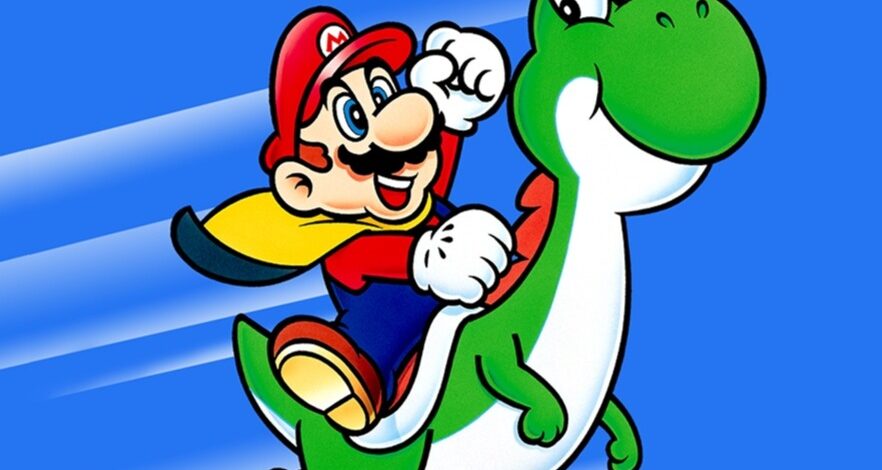
A 16-Bit Landmark That Earned Its Legend
Super Mario World snes is one of those games that makes the word “classic” feel too small. Released as a Super Nintendo launch title in Japan in 1990 and North America in 1991, it had an enormous job: prove that Nintendo’s new 16-bit machine was not just a prettier NES. It had to sell the future. Somehow, Mario did it while riding a green dinosaur, wearing a cape, and hiding more secrets than most games dare to attempt.
This was not just another sequel. Super Mario Bros. 3 had already perfected the idea of the world-map platformer, so Nintendo could have played it safe. Instead, Super Mario World expanded the formula with Dinosaur Land, branching paths, secret exits, ghost houses, switch palaces, Star Road, and the unforgettable debut of Yoshi. Even decades later, it feels less like a museum piece and more like a game that escaped time completely.
History and Context
As a launch game, Super Mario World carried the Super Nintendo on its back. The SNES needed an instant identity, and Nintendo delivered a game that felt familiar enough for NES fans but fresh enough to show off the new hardware. It did not rely on gimmicks or brute-force spectacle. Instead, it demonstrated polish, color, animation, and design confidence.
The arrival of Yoshi was a massive moment. He was not just a cute mascot slapped onto the box. He changed how you moved, attacked, explored, and thought about levels. Swallowing enemies, gaining shell powers, fluttering across gaps, and taking that emergency hit made him feel like a true companion. For many players, this was the point where Mario’s universe stopped feeling like a string of obstacle courses and started feeling like a living cartoon world.
Super Mario World also helped define what people expected from 16-bit platformers. It was not the loudest game on the system, nor the most technically flashy, but its influence is everywhere. Any platformer with hidden routes, collectible exits, layered overworlds, or movement-based mastery owes something to this game.
Gameplay: Simple Controls, Ridiculous Depth
The genius of Super Mario World is that it feels perfect within seconds. Mario accelerates smoothly, jumps with clean weight, and responds exactly when you need him to. There is a slight slipperiness compared to some later entries, but once it clicks, it becomes part of the rhythm. You are not just moving through levels; you are dancing with them.
The power-ups are limited compared to some Mario games, but every one matters. The Super Mushroom gives confidence. The Fire Flower lets you attack from a distance. The Cape Feather, though, is the superstar. At first, it seems like a simple replacement for the raccoon tail from Super Mario Bros. 3. Then you learn to run, lift off, dive, swoop back up, and suddenly entire levels become playgrounds. Mastering cape flight is one of the great joys of the SNES era.
Level design is where the game becomes legendary. Nintendo constantly teaches without lecturing. A safe setup introduces an idea, a trickier version tests it, and a later challenge asks whether you were paying attention. One level may focus on moving platforms, another on swimming, another on vertical climbing, another on digging through chocolate-colored terrain. The variety is wild, but the rules always feel fair.
The world map is not just decoration. It is a puzzle box. Secret exits can open alternate routes, shortcuts, hidden switch palaces, and entirely new regions. Seeing a path appear where you thought the map was finished is still exciting. The famous 96 exits give completionists a real reason to poke every suspicious pipe, keyhole, and oddly placed platform. This is exploration disguised as a platformer.
Graphics: Bright, Clean, and Still Beautiful
Super Mario World snes does not chase realism, and thank goodness for that. Its visuals are bold, readable, and bursting with personality. The color palette is cheerful without becoming noisy, and everything important is clear at a glance. Enemies pop from the background, platforms are easy to judge, and Mario’s animations sell every hop, skid, spin jump, and cape twirl.
Compared to later SNES showcases, the game can look visually simple, but that simplicity is part of its strength. The art direction has aged beautifully because it values clarity over clutter. Donut Plains feels breezy, Vanilla Dome feels cool and underground, the Forest of Illusion feels mysterious, and Chocolate Island has that wonderfully strange Mario weirdness where nothing needs to make sense as long as it feels fun.
There are also little touches that still charm. Yoshi’s cheeks puff when he eats. Koopas wobble out of shells. Rex enemies shrink when stomped. Ghost Houses use eerie stillness and trick doors to change the mood entirely. Bowser’s final battle, with its flying clown car and dramatic stormy backdrop, remains one of the most memorable finales on the system.
Sound and Music: Koji Kondo Magic
The soundtrack is pure Koji Kondo craftsmanship. The main overworld theme is bouncy and warm, but the real brilliance is how the music shifts across situations. The underground theme has a playful echo. The Ghost House music is spooky without becoming oppressive. The athletic theme is impossible not to hum. Even the castle music has that perfect blend of danger and momentum.
One of the coolest audio tricks is the Yoshi percussion. When Mario hops onto Yoshi, extra drum beats slide into the music, making the soundtrack feel alive. It is a small detail, but it tells you everything about Nintendo’s attention to joy. The game does not just give you a mount; it makes the whole world sound happier when you find him.
The sound effects are equally iconic. The coin chime, cape spin, Yoshi gulp, power-up sparkle, and checkpoint ding are burned into gaming memory. They are crisp, satisfying, and never irritating, even after hours of play. That matters in a game built around replaying, exploring, and occasionally failing spectacularly.
Difficulty: Friendly Until It Bites
Super Mario World is welcoming, but it is not toothless. The main route is easier than many NES platformers, which makes it perfect for new players. Extra lives are generous, checkpoints are common, and Yoshi provides a helpful safety net. If you simply want to reach Bowser, the game gives you room to learn.
But if you want everything, the gloves come off. Secret exits can be devious, especially in Ghost Houses and the Forest of Illusion. Some levels hide keys in places that require curiosity, skill, or both. Then there is the Special Zone, home to stages with names like Tubular and Outrageous, which feel like Nintendo smiling politely before throwing you into a blender.
The best part is that the difficulty rarely feels cheap. When you mess up, you usually know why. You jumped too early, flew too greedily, ignored the enemy pattern, or trusted a platform that was clearly up to no good. That sense of responsibility keeps frustration from overpowering the fun.
Final Verdict
Super Mario World snes is not beloved because of nostalgia alone. Nostalgia may get you through the door, but the design keeps you there. This is a game with near-perfect controls, brilliant secrets, unforgettable music, charming visuals, and a structure that rewards both casual play and obsessive completion. It is easy to enjoy and hard to exhaust.
Is it flawless? Almost, but not entirely. Some boss fights are simple, a few secret exits are a little too cryptic, and players raised on newer Mario games may need a moment to adjust to the physics. Still, those are tiny scratches on a golden cartridge. Super Mario World remains one of the greatest platformers ever made and arguably the defining game of the SNES library.
If you own a Super Nintendo, this is mandatory. If you collect retro games, it belongs on your shelf. If you somehow missed it, fix that. Super Mario World is joyful, clever, endlessly replayable, and still capable of making a grown player grin like a kid on a Saturday morning.
Score: 10/10
Buy Super Mario World snes on eBay
Looking for a copy of Super Mario World snes?
View current eBay listings