
History: The Moment Zelda Changed Forever
Reviewing the legend of zelda ocarina of time n64 in the modern era is a little dangerous, because the game comes with decades of reputation strapped to its back. It is not just “that old Zelda game.” It is the cartridge that taught a generation what 3D adventure could feel like. Released in 1998 for the Nintendo 64, Ocarina of Time arrived at a point when developers were still figuring out how to move beloved 2D series into polygonal worlds without losing their soul.
Nintendo did not merely translate Zelda into 3D. It rebuilt the language. Lock-on targeting, contextual buttons, cinematic dungeon reveals, horseback exploration, musical puzzle solving, and a world that felt mythic without being bloated all came together in one impossibly confident package. Plenty of games age into museum pieces. Ocarina of Time still feels like a living blueprint.
The story is classic fantasy, but delivered with just enough mystery and melancholy to stick. Young Link leaves Kokiri Forest, meets Princess Zelda, draws the Master Sword, and awakens years later to a ruined Hyrule under Ganondorf’s rule. That time jump remains one of gaming’s great “wait, what just happened?” moments. It gives the adventure weight. You are not just collecting items. You are seeing innocence broken and fighting to restore it.
Gameplay: Adventure Design That Still Has Teeth
The core loop is pure Zelda magic: explore the overworld, find a dungeon, earn a new item, use that item to solve puzzles and defeat a boss, then watch the world open a little wider. What makes Ocarina of Time special is how elegantly everything feeds into everything else. The slingshot, boomerang, bombs, hookshot, bow, Lens of Truth, and elemental arrows are not disposable gimmicks. They are keys to both progression and discovery.
Z-targeting deserves its own applause. On paper, holding a button to focus on an enemy sounds simple. In practice, it made 3D combat understandable. Stalfos duels feel like actual sword fights, Lizalfos leap around with menace, and even basic Deku Scrubs teach spacing and timing. The system is so natural now because Ocarina of Time made it natural.
The dungeons are the real feast. Inside the Great Deku Tree is a perfect tutorial dungeon, compact and readable without feeling patronizing. Dodongo’s Cavern brings scale and danger. Jabu-Jabu’s Belly is weird, squishy, and mildly annoying in that very Zelda way. Then the adult dungeons crank everything up. The Forest Temple is eerie and brilliant, the Fire Temple is dramatic, the Water Temple is infamous, and the Shadow Temple feels like Nintendo briefly remembered horror existed.
Yes, the Water Temple can be a pain, especially in the original N64 version where switching the Iron Boots requires pausing and digging through menus. But I will defend its ambition. It is a giant mechanical puzzle box built around water levels, spatial memory, and patience. Frustrating? Absolutely. Bad? Not really. It asks more of the player than most games dared to ask in 1998.
Exploration: Hyrule Field Still Has Magic
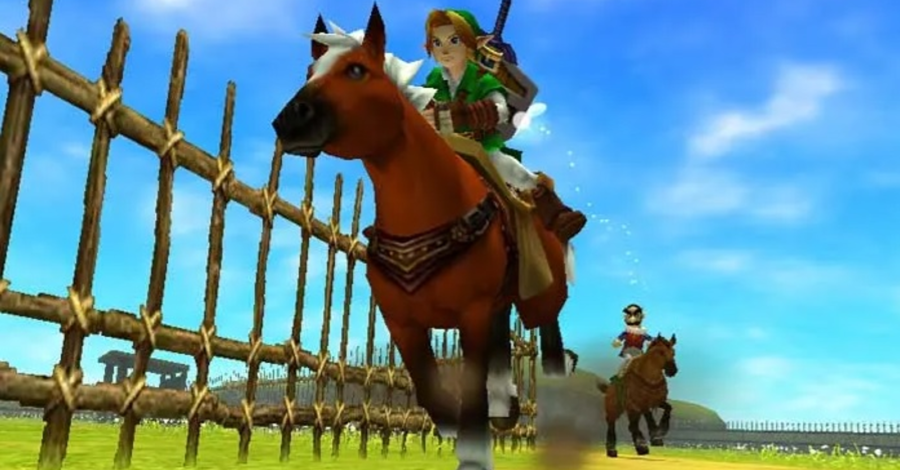
By today’s open-world standards, Hyrule Field is not massive. You can cross it quickly, and much of it is empty grass. But size was never the point. The magic is in the sense of possibility. Seeing Death Mountain in the distance, spotting Lon Lon Ranch in the center, racing the drawbridge before night falls, hearing the Stalchildren claw out of the ground after sunset; these moments make the world feel alive.
Ocarina of Time also understands pacing. It does not bury you in icons or errands. It gives you rumors, odd characters, locked doors, suspicious cracks in walls, and songs that change how you interact with the land. Epona is more than faster transportation; she makes Hyrule feel like a place worth riding through. The ocarina songs are more than melodies; they are tools, memories, and emotional anchors.
Side content is handled with charm rather than checklist fatigue. Fishing is weirdly addictive. The trading sequence is memorable. Gold Skulltulas reward obsessive exploration. The Happy Mask Shop is goofy until it starts feeling strangely important. Even optional upgrades feel meaningful because the game’s world is dense with secrets instead of cluttered with chores.
Graphics: Blocky, Moody, and Iconic
Let’s be honest: the legend of zelda ocarina of time n64 looks like an N64 game. Characters have chunky limbs, faces are painted with simple textures, and some environments are swallowed by fog. If you are coming straight from modern remakes and high-definition fantasy epics, the original cartridge can look rough at first glance.
But give your eyes a few minutes to adjust and the art direction takes over. Kokiri Forest glows with storybook warmth. Hyrule Castle Town feels cheerful before becoming devastated in the adult timeline. The Forest Temple uses twisting corridors, haunting courtyards, and cold stone to create atmosphere that goes way beyond polygon count. The Shadow Temple, with its skulls, invisible paths, and torture-chamber energy, is still nasty in the best way.
The animations also carry more personality than you might expect. Link’s rolls, sword swings, shield blocks, and little idle movements sell the character. Ganondorf’s posture radiates arrogance. The bosses are huge and theatrical, from King Dodongo’s lumbering bulk to Phantom Ganon riding through paintings. The game may be technically dated, but its visual identity remains strong because it knows exactly what mood each area needs.
Sound: Koji Kondo at Full Power
The soundtrack is one of the biggest reasons Ocarina of Time refuses to fade. Koji Kondo’s music does not merely accompany the adventure; it defines it. The title screen, with Epona galloping under moonlight while the ocarina plays, is enough to make longtime fans sit up straighter. Kokiri Forest is playful. Gerudo Valley is an all-time banger. The Temple of Time theme feels sacred, lonely, and enormous.
What is brilliant is how music becomes part of the controller. The ocarina is not a menu option disguised as an instrument. You play notes. You remember patterns. You summon storms, change day to night, warp across Hyrule, and connect with characters through songs. Saria’s Song feels like friendship. Zelda’s Lullaby feels like destiny. The Song of Storms feels like some cursed tavern tune you will never get out of your head.
Sound effects are just as memorable. The secret chime is dopamine in audio form. The low-health beep is irritating enough to become legendary. Navi’s “Hey! Listen!” can drive you mad, but it also became part of gaming history. Sword clashes, treasure openings, enemy cries, and boss roars all have that crisp Nintendo readability. You always know what is happening, even when the camera gets dramatic.
Difficulty: Fair, Occasionally Fussy, Never Toothless
Ocarina of Time is not brutally difficult, but it expects attention. Modern players used to constant objective markers may be surprised by how much the game trusts them. It nudges, hints, and points, but it rarely drags you by the tunic. If someone says to check Death Mountain or visit a village, you are expected to remember that.
Combat starts forgiving and becomes sharper as enemies demand blocking, dodging, and counterattacking. Bosses are mostly puzzle fights, but they are satisfying puzzle fights. Figuring out the item gimmick is half the battle, while execution provides the thrill. Volvagia is cinematic, Bongo Bongo is tense, and the final showdown with Ganondorf still lands because the game has built him up properly.
The real difficulty comes from navigation and puzzle logic. Some clues are subtle. Some dungeon layouts are complex. The original N64 interface can be clunky, especially when swapping boots or managing items. The camera, while groundbreaking, is not perfect, and tight spaces occasionally remind you this was early 3D territory. Still, these rough edges rarely ruin the experience. They are the scuffs on a beloved cartridge, not cracks in the design.
Final Verdict: A Masterpiece With the Dust Still Shining
The Legend of Zelda: Ocarina of Time is not flawless. The frame rate is low, the models are old, the interface has aged, and a few sections can feel slow by modern standards. But judging it only by modern convenience misses why it still matters. This game has atmosphere, confidence, structure, and heart. It knows when to be quiet. It knows when to scare you. It knows when to let a melody do the emotional heavy lifting.
More importantly, it remains fun. Not “important for its time” fun. Not “you should respect it” fun. Actual, controller-in-hand, one-more-dungeon fun. The legend of zelda ocarina of time n64 is still one of the strongest adventure games ever made because its design fundamentals are rock solid. Exploration rewards curiosity. Dungeons challenge your brain. Combat feels readable. The world has personality. The story is simple but mythic.
If you own an N64, this is essential. If you collect retro games, it is a cornerstone. If you somehow skipped it because the hype sounded impossible to live up to, play it anyway. Ocarina of Time is one of those rare classics where the legend is loud, but the cartridge still backs it up.
Score: 10/10
Buy legend of zelda ocarina of time n64 on eBay
Looking for a copy of legend of zelda ocarina of time n64?
View current eBay listings